Tuesday, 29 November 2016
Engaging students with the fundamentals of biodiversity
This term we have started refreshing and reformatting our first year undergraduate modules, partly in preparation for the move to our new Waterside Campus, but also because they were beginning to feel a bit tired and jaded. We have begun with ENV1012 Biodiversity: an Introduction, a 20 CATS module which mainly services our BSc Environmental Science and BSc Biology programmes.
One of the changes has been to go from a “long-thin” delivery of 2 class hours per week over two terms, to a “short-fat” delivery of 4 hours per week in one term. The advantages of this, we think, are two-fold: (1) it provides students with a richer, more immersive experience because they are not mind-flitting between different topics; (2) it frees up longer blocks of time for academic staff to focus on programme development, research activities, etc.
For now we have opted to deliver the 4 hours in a single session. That’s quite a long time for the students (and staff) to be taught (teaching) but it’s punctuated by short breaks and includes a lot of practical work in the field, lab, and computer suite.
One of the aims of ENV1012 Biodiversity: an Introduction is to engage the students with the use of taxonomic names of species and higher groups, familiarise them with the principles of biological classification, why this is important (and why it underpins the rest of biology and much of the environmental sciences), and so forth. Building confidence in how scientific names are used, and the diversity of species that all of us encounter on a day-to-day basis, are important aspects of this, and I developed a couple of new exercises that we are trialling this term which are focused on these areas.
The first one is called “The Taxonomy of Gastronomy” and was partly inspired by a conversation I had with Steve Heard when he posted about The Plant Gastrodiversity Game. It works like this. I begin with an interactive lecture that sets out the basic ideas behind taxonomic classification and its importance. After a short break the students then begin the hands-on part of the exercise. Working in groups of three they use a work sheet that lists 10 culinary dishes, including: fried cod, chips, and mushy peas; spotted dick; spaghetti bolognese; Thai green curry with tofu & okra; chocolate brownies, etc. (this can easily be varied and adapted according to needs).
The students’ first task is to find a recipe online for each dish. For each biological ingredient in that dish, they list its common name and find its taxonomic family, genus, and species (italicising the latter two, as per taxonomic conventions). I emphasise that it is important to be accurate with names as they will be doing something similar in a later assessed exercise.
This takes a couple of hours and then they feedback their results in a debriefing session, including finding out who had the longest list of species in a meal – the winner was 17 species in a moussaka recipe, with a Jamie Oliver fish and chips recipe coming a credible second with 12! We also discuss particularly common taxa that turn up frequently, for example plant families such as Solanaceae – the relatedness of tomatoes, chillies, peppers, potatoes, and aubergine, the students found very intriguing.
By the end of this exercise the students will have gained familiarity with researching, understanding, handling, and writing scientific names of species and higher taxonomic groups. In addition they will have a better understanding of the taxonomic diversity of organisms that we consume, and their relatedness. It may also have encouraged them to try out some new recipes!
If anyone wishes to comment or add suggestions for improvements, please do. If you’d like to try this yourself with your own students feel free to adapt it to your own needs, though an acknowledgement somewhere would be polite.
Prof Jeff Ollerton
This article was first published on Jeff's blog here

Friday, 25 November 2016
Department staff assess biodiversity impact of new Waterside Campus
The University of Northampton is building a new campus, in the heart of Northampton. The Waterside Campus will open in September 2018.
Researchers within the Department of Environmental and Geographical Sciences have been monitoring the effects of the building work on biodiversity. You can read more about this research here.
Researchers within the Department of Environmental and Geographical Sciences have been monitoring the effects of the building work on biodiversity. You can read more about this research here.
Monday, 14 November 2016
Game helps Geography students understand the impacts of climate change
We welcomed Frank Sudlow from the Catholic Fund for Overseas
Development (CAFOD) to our 'Geography and Development' session last week and he led a simulation exercise
on the effects of climate change on poor families from around the Global South.
 |
| Students worked in 'family' groups to produce materials for market |
 |
| Goods produced by the families |
Families took their bundles of coffee, latex, goat hides or
other commodities to a market over which they had no control and had to accept
whatever the market decided to give them. Poor produce was rejected. As the
game proceeded, families often fell below the poverty line and all
production stopped until they had completed a set task. At regular intervals a
radio message was broadcast impacting on the livelihoods of a particular
family.
 |
| A big queue at the marketplace |
 |
| The price paid for each good varied throughout the game, according to different climate conditions |
A spreadsheet helped to keep a tally of how families were
managing and, after several ‘years’, a plenary session helped us to understand
the lessons learned. It was clear that climate change is proving to be a major
problem for poor families living in the Global South and is seriously limiting
their livelihood development. Only one family, through very careful
organisation and a certain amount of ‘luck’ managed to progress out of poverty.
Most ended up poorer than when they started.
 | |
|
 |
| Kevin keeps a close eye on the figures |
Everyone agreed that this was an excellent way to be made to
think about some of the major effects of climate change. Thanks Frank for a stimulating and enjoyable
session. We hope Frank will be able to join us again next year.
 |
| Frank provides a summary at the end of the session |
Dr Kevin Cook, Senior Lecturer in Geography
Monday, 31 October 2016
Geography fieldwork in central London
At the end of October three groups of geography students travelled down to central London for a day of fieldwork.
First year students have been exploring representations of place in their GEO1006 Introducing Human Geographies class. They have been reflecting on what type of information is presented on maps - and what missing. To examine this themselves in the field, they worked in groups to develop a walking trail for visitors to central London, including themes and locations not usually covered in a tourist trail.
Second year students taking GEO2030 Transport travelled across the city using various types of public transport, to better understand connectivity in transport networks.
Dr Chris Holt took third year students doing GEO3124 Water Resource Management on a tour of rivers in London. They considered how water is managed in the capital.
 |
| An early start |
First year students have been exploring representations of place in their GEO1006 Introducing Human Geographies class. They have been reflecting on what type of information is presented on maps - and what missing. To examine this themselves in the field, they worked in groups to develop a walking trail for visitors to central London, including themes and locations not usually covered in a tourist trail.
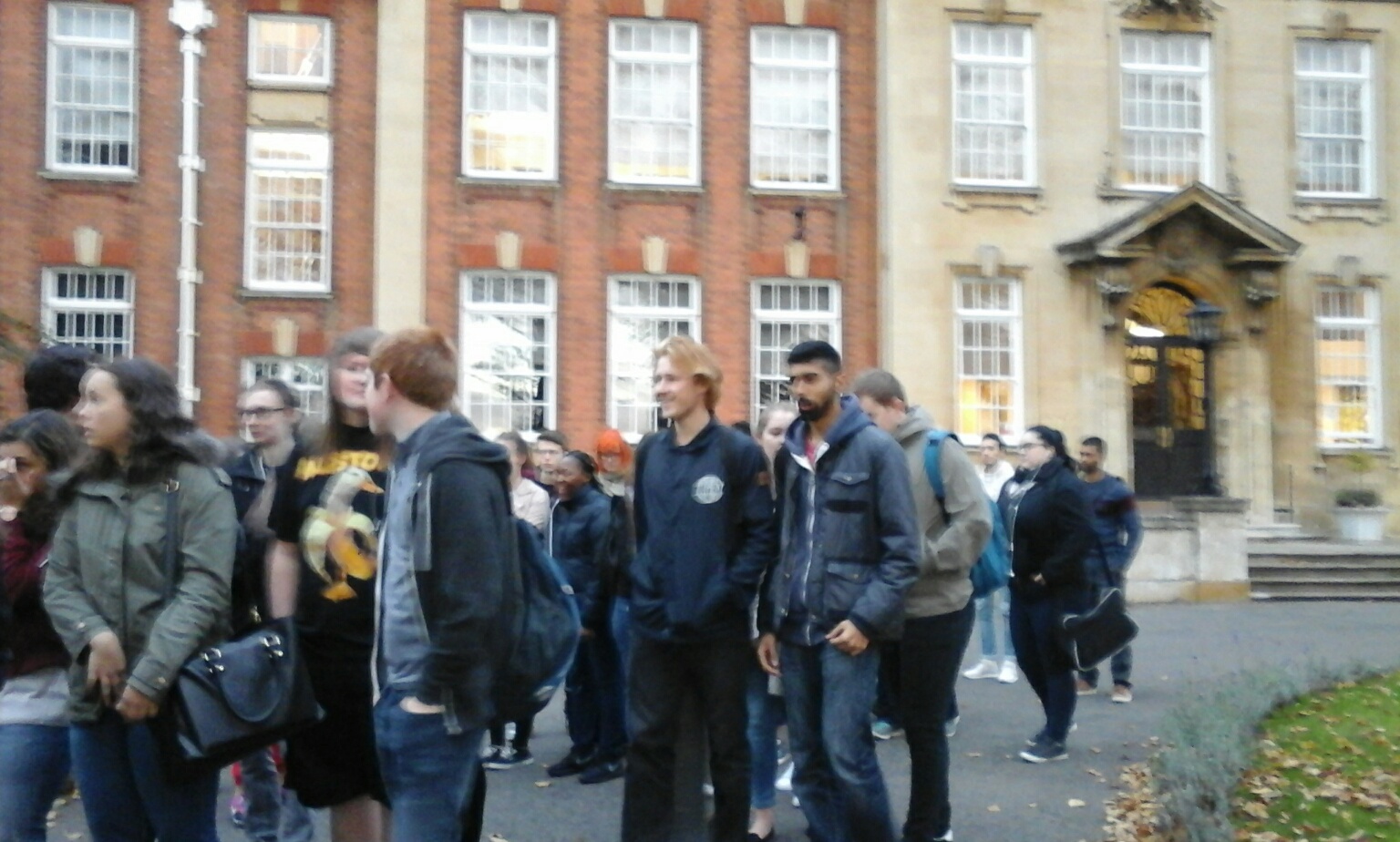 |
| Meeting outside Newton building |
 |
| The coaches await! |
 |
| An opportunity for students of different year groups to get to know each other |
Second year students taking GEO2030 Transport travelled across the city using various types of public transport, to better understand connectivity in transport networks.
Dr Chris Holt took third year students doing GEO3124 Water Resource Management on a tour of rivers in London. They considered how water is managed in the capital.
 |
| Dr Chris Holt enjoying the banter on the bus! |
Tuesday, 25 October 2016
Learning about the social construction of childhood
Third year Geography students recently spent a day in London, looking at the social construction of childhood.
The students - all of whom are studying GEO3007 Children's Geographies - visited the Museum of Childhood and the National Portrait Gallery.
At the Museum of Childhood they looked at how experiences of childhood have varied over time. There were also opportunities for us to critically reflect on our own childhood experiences - and to play with some toys!
After a lunch break near Trafalgar Square, the group visited the National Portrait Gallery. This provided opportunities to critically reflect on representations of childhood - and to consider how these have changed over time.
 |
| Getting ready for the trip |
 |
| Meeting at Northampton train station - an early start to the day |
The students - all of whom are studying GEO3007 Children's Geographies - visited the Museum of Childhood and the National Portrait Gallery.
At the Museum of Childhood they looked at how experiences of childhood have varied over time. There were also opportunities for us to critically reflect on our own childhood experiences - and to play with some toys!
 |
| Learning about how childhood has changed over time |
 |
| Learning about the development of board games (or auditioning for a role as a game show host?) |
 |
| Trying out some of the games |
 |
| Taking a break to explore some of the National Portrait Gallery's collections online |
 |
| A bit tired after a busy day! |
Monday, 24 October 2016
Professor Margaret Bates inaugurated as new President of Chartered Institution of Wastes Management
Last week Prof Margaret Bates was inaugurated as the new President of the Chartered Institution of Wastes Management.
Full details of the event can be found here.
Full details of the event can be found here.
Friday, 21 October 2016
Students visit Natural History Museum
This week second year Geography and Environmental Science students taking GEO2114 Earth Science visited the Natural History Museum in London.
 |
| Meeting outside Newton building at 8.00am |
 |
| Lots of enthusiasm for an early start! |
The group explored a number of galleries. They focused on rocks and minerals, and examined fossils - and dinosaurs! - too.
 |
| The minibus awaits! |
Subscribe to:
Posts (Atom)