Welcome

This blog is written by the Environmental and Geographical Sciences team at the University of Northampton. This will keep you up to date with both student and staff activities.

The Environmental and Geographical Sciences team includes staff with interests in biological sciences, conservation, ecology, environmental sciences, environmental statistics, geography and waste management. We offer a range of degree programmes and have a number of postgraduate research students. For more information about studying with us please visit http://www.northampton.ac.uk/.

Friday, 3 March 2017

Geography students learn about the challenging issues surrounding Female Genital Mutilation


Dr Kevin Cook reports on a recent class about the challenging issues surrounding Female Genital Mutilation...

As I move towards the end of my second year module on Geography and Development, I have the opportunity to deal with some of the more challenging issues that face the world. I wanted to try to cover the complex issue of Female Genital Mutilation (FGM) but was keenly aware of my limited understanding of the issues involved and wanted to provide a view from the Global South delivered by ‘practitioners’ working in the field.

I had heard about the excellent work of the UK charity Tanzania Development Trust (TDS) and knew that they worked with communities on FGM. I contacted them and Janet Chapman, Campaigns Manager and Project Officer, kindly offered to set up a Skype session with my students. We linked up with Egle Marija Ramanauskaite in London and Rhobi Samwelli, the TDS representative in the Mara Region in Tanzania.
Tanzania Development Trust logo
The twin highlights of the session were being able to talk directly, via Skype, with Rhobi Samwelli. Rhobi manages a safe house at Mugumu in Mara region for young women who wish to escape the horrors of FGM. The UK students were able to ask Rhobi detailed questions on FGM; questions that I would have been unable to answer.

The second highlight of the session was being able to take part in the online mapping project that Janet is looking after. One of the many problems facing young girls who wish to avoid being cut, is to find their way to the TDS funded safe house at Mugumu. There are no maps to guide them and Janet is using the mapping software package, Openstreetmap, accessible online and on phones.


Students were allocated a small un-mapped square and it soon became a competition to see who could identify the most buildings, roads and paths from the satellite images and transfer them to the base map. Their efforts will be confirmed on the ground later.

Over 900 online volunteers and 199 local mappers are now involved in the project – make that 925 with the University of Northampton students added. They have mapped an area of 14,248 square kilometres and added 5 towns and 169 villages and hamlets, 42,128 km of roads and tracks and 700,000 buildings. Countrywide the project has added 12,294 schools and 162 clinics.

Having better maps helped prevent 2257 girls from being cut in the 2016-17 season. However change is a slow process. 1076 girls were still cut, down from 3700 the previous year and 4 girls died, down from 12 last year.

Many thanks to everyone who made this session possible and especially to Janet, Egle, Rhobi and the GEO2006 students.

Anyone wanting to get involved in this work should contact Janet at j.chapman@tanzdevtrust.org

Wednesday, 15 February 2017

Guest speaker tells students about research on agriculture and NGOs in northern Ghana


Rachael Taylor, a post-graduate research student at the University of Sussex, gave a guest lecture to Geography students on  her research in northern Ghana. Rachael is examining ideas associated with what is known as 'adaptive capacity' - how subsistence families adapt to change.
The lecture covered a range of topics (source: Rachael Taylor)
She provided examples of NGO action and showed how this can vary from highly successful and sustainable, to poor and unsustainable.
Learning about diverse agricultural livelihoods (source: Rachael Taylor)
There were opportunities for the class to ask questions about her research and to learn more about the work of NGOs.

Monday, 23 January 2017

Evaluating accessibility on campus

First year Geography students have been learning about accessibility issues on campus. The project links to classes on geographies of disability, and staff research on accessibility issues.

Some groups borrowed a wheelchair to help them evaluate campus spaces. They took measurements of slopes, door widths etc, and tried negotiating particular pathways and corridors.

Thinking about how the angle of slopes can help or impede wheelchair access
Trying popular routes around campus
Thinking about the width of pathways
Other groups used goggles to help them understand the experiences of people with common visual impairments. They thought about challenges related to climbing stairs, reading signs, and crossing roads.
Using goggles to help give some insights into some common visual impairments
This project work has been supported by the University's ASSIST team, who provide support to students with a wide range of disabilities and additional needs.

Friday, 13 January 2017

Geography programmes accredited by Royal Geographical Society (with IBG)


In December 2016 we heard the great news that our Single Honours Geography programmes have been accredited by the the Royal Geographical Society (with IBG).


Accredited degree programmes contain a solid academic foundation in geographical knowledge and skills, and prepare graduates to address the needs of the world beyond higher education. The accreditation criteria require evidence that graduates from accredited programmes meet defined sets of learning outcomes, including subject knowledge, technical ability and transferable skills.

To find out more about our Geography programmes click here, or come to one of our Open Days.

Thursday, 12 January 2017

Fossil hunting at Wren's Nest, Dudley

Second year Geography students recently visited Wren's Nest, Dudley, as part of their 'Earth Science' module.
Arriving at Wren's Nest
Wren's Nest contains superb exposures of rocks from the middle Silurian period. This provides great opportunities for fossil hunting!
On the hunt for some lovely fossils
Learning to identify fossils
We found a range of interesting fossils, including this fabulous trilobite!
A rather nice trilobite

Monday, 12 December 2016

Geography students raise money for Wells for India


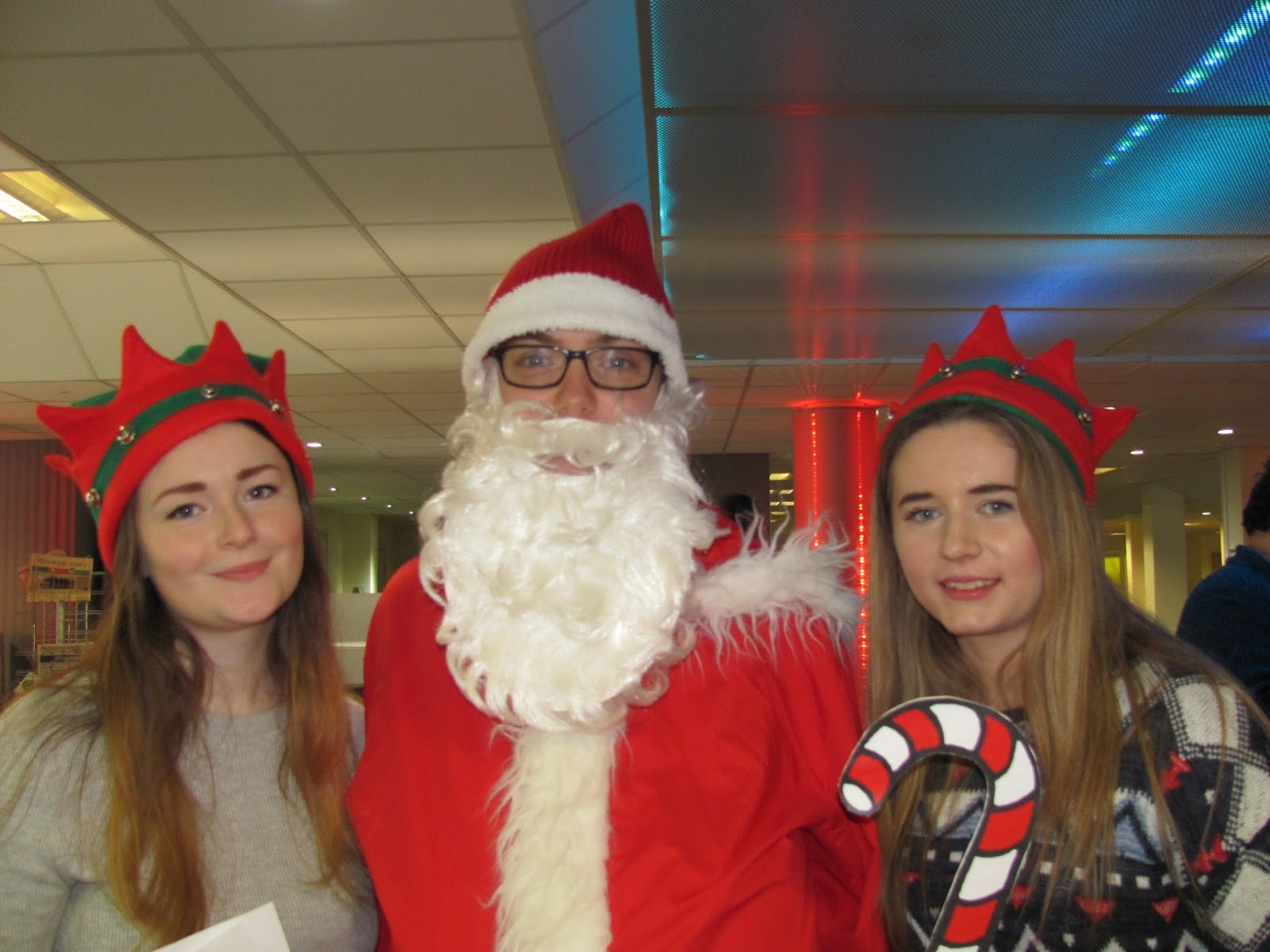
First year Geography students organised a Christmas Fair on campus to raise money for Wells for India. They learned about the work of the charity as part of their Sustainable Development module. Classes  helped the students to understand about various ways of enhancing water access and water quality in dryland environments, and to think critically about the sustainability of development projects.


The event included festive games, such as ‘pin the nose on Rudolph’ and ‘where in the world is Santa’. There was also a bottle tombola, guess the name of the teddy, guess the number of sweets in a jar, and home-made Christmas cards for sale.
Festive games included 'pin the nose on Rudolph'
Guess the name of the teddy was a popular game

Students and staff had an opportunity to get a selfie with Santa too!

The students raised £136.19.

Wednesday, 30 November 2016

Classes on poverty inspire students to donate to local good causes

Second year Human Geography students have been learning about issues relating to poverty, deprivation and social exclusion in the UK. Alongside lectures on geographies of homelessness, food poverty, and mobility deprivation, students have had the chance to meet a range of guest speakers from local front-line organisations, charities and services. Guest speakers have included:
Lots of craft materials, puzzles, games and warm clothing  for Age UK day centres in Northamptonshire
Students have also been active in collecting donations for these organisations. In a fantastic effort this term, students have so far collected:

  • 70 items of toiletries and 20 cartons of UHT milk (all items urgently needed by local food banks)
  • 12 scarves, and several bags full of puzzles and craft materials for day centres for isolated elderly people;
  • several car boots full of food and clothing donations for local food banks.
 
Lots of items donated for the foodbank!
Providing some of the most-needed items for Spencer Bridge Foodbank

I have a feeling there will be another car boot full of items next week!...

Prof John Horton