Welcome

This blog is written by the Environmental and Geographical Sciences team at the University of Northampton. This will keep you up to date with both student and staff activities.

The Environmental and Geographical Sciences team includes staff with interests in biological sciences, conservation, ecology, environmental sciences, environmental statistics, geography and waste management. We offer a range of degree programmes and have a number of postgraduate research students. For more information about studying with us please visit http://www.northampton.ac.uk/.

Showing posts with label international development. Show all posts

Monday, 9 October 2017

Geographers learn about water issues from India Director of WaterHarvest charity

On Thursday 6th October second year Geography and Development students were joined by Om Prakash Sharma, Indian Director of the charity WaterHarvest.

Om Prakash Sharma, Indian Director of WaterHarvest charity, with students. (Photo: Chris Fidler)

Om gave an illustrated lecture and answered questions on the topic of water harvesting in semi-arid areas of Rajasthan, India. He drew attention to the conflicts between large scale government projects such as the transfer of water from river to river across India and the traditional village scale water harvesting methods such as the taanka and the chauka.

Om is currently visiting the UK and we were honoured to have him join us for the session.

Monday, 13 March 2017

Northampton graduate returns to campus to talk about her work on health and development


Sonia Coates is a graduate of the University of Northampton and now works as a consultant for IOD PARC, a development consultancy based in Sheffield. Sonia recently returned to class to talk about her experiences as a development consultant.
Sonia Coates
Sonia is currently a team member working to provide technical assistance and Institutional support to UNICEF India for their reducing Open Defecation programme, and has recently completed a piece of participatory research looking at the impacts of WASH on education for girls in Zimbabwe for Plan International. She has experience of managing multi-country projects across sub-Saharan Africa and has also worked in S E Asia. She has a Masters in Public Health and International Development.

The session was illustrated with material from Sonia's work in Malaysia, Nepal, India and several sub-Saharan countries. She discussed various issues, including Water and Sanitation, child health, infectious and neglected tropical diseases.

Sonia answered students' questions on careers in development - and provided some top tips for those interested in working in this sector.
Sonia's top tips for developing a career in International Development


Friday, 3 March 2017

Geography students learn about the challenging issues surrounding Female Genital Mutilation


Dr Kevin Cook reports on a recent class about the challenging issues surrounding Female Genital Mutilation...

As I move towards the end of my second year module on Geography and Development, I have the opportunity to deal with some of the more challenging issues that face the world. I wanted to try to cover the complex issue of Female Genital Mutilation (FGM) but was keenly aware of my limited understanding of the issues involved and wanted to provide a view from the Global South delivered by ‘practitioners’ working in the field.

I had heard about the excellent work of the UK charity Tanzania Development Trust (TDS) and knew that they worked with communities on FGM. I contacted them and Janet Chapman, Campaigns Manager and Project Officer, kindly offered to set up a Skype session with my students. We linked up with Egle Marija Ramanauskaite in London and Rhobi Samwelli, the TDS representative in the Mara Region in Tanzania.
Tanzania Development Trust logo
The twin highlights of the session were being able to talk directly, via Skype, with Rhobi Samwelli. Rhobi manages a safe house at Mugumu in Mara region for young women who wish to escape the horrors of FGM. The UK students were able to ask Rhobi detailed questions on FGM; questions that I would have been unable to answer.

The second highlight of the session was being able to take part in the online mapping project that Janet is looking after. One of the many problems facing young girls who wish to avoid being cut, is to find their way to the TDS funded safe house at Mugumu. There are no maps to guide them and Janet is using the mapping software package, Openstreetmap, accessible online and on phones.


Students were allocated a small un-mapped square and it soon became a competition to see who could identify the most buildings, roads and paths from the satellite images and transfer them to the base map. Their efforts will be confirmed on the ground later.

Over 900 online volunteers and 199 local mappers are now involved in the project – make that 925 with the University of Northampton students added. They have mapped an area of 14,248 square kilometres and added 5 towns and 169 villages and hamlets, 42,128 km of roads and tracks and 700,000 buildings. Countrywide the project has added 12,294 schools and 162 clinics.

Having better maps helped prevent 2257 girls from being cut in the 2016-17 season. However change is a slow process. 1076 girls were still cut, down from 3700 the previous year and 4 girls died, down from 12 last year.

Many thanks to everyone who made this session possible and especially to Janet, Egle, Rhobi and the GEO2006 students.

Anyone wanting to get involved in this work should contact Janet at j.chapman@tanzdevtrust.org

Wednesday, 15 February 2017

Guest speaker tells students about research on agriculture and NGOs in northern Ghana


Rachael Taylor, a post-graduate research student at the University of Sussex, gave a guest lecture to Geography students on  her research in northern Ghana. Rachael is examining ideas associated with what is known as 'adaptive capacity' - how subsistence families adapt to change.
The lecture covered a range of topics (source: Rachael Taylor)
She provided examples of NGO action and showed how this can vary from highly successful and sustainable, to poor and unsustainable.
Learning about diverse agricultural livelihoods (source: Rachael Taylor)
There were opportunities for the class to ask questions about her research and to learn more about the work of NGOs.

Monday, 12 December 2016

Geography students raise money for Wells for India


First year Geography students organised a Christmas Fair on campus to raise money for Wells for India. They learned about the work of the charity as part of their Sustainable Development module. Classes  helped the students to understand about various ways of enhancing water access and water quality in dryland environments, and to think critically about the sustainability of development projects.


The event included festive games, such as ‘pin the nose on Rudolph’ and ‘where in the world is Santa’. There was also a bottle tombola, guess the name of the teddy, guess the number of sweets in a jar, and home-made Christmas cards for sale.
Festive games included 'pin the nose on Rudolph'
Guess the name of the teddy was a popular game

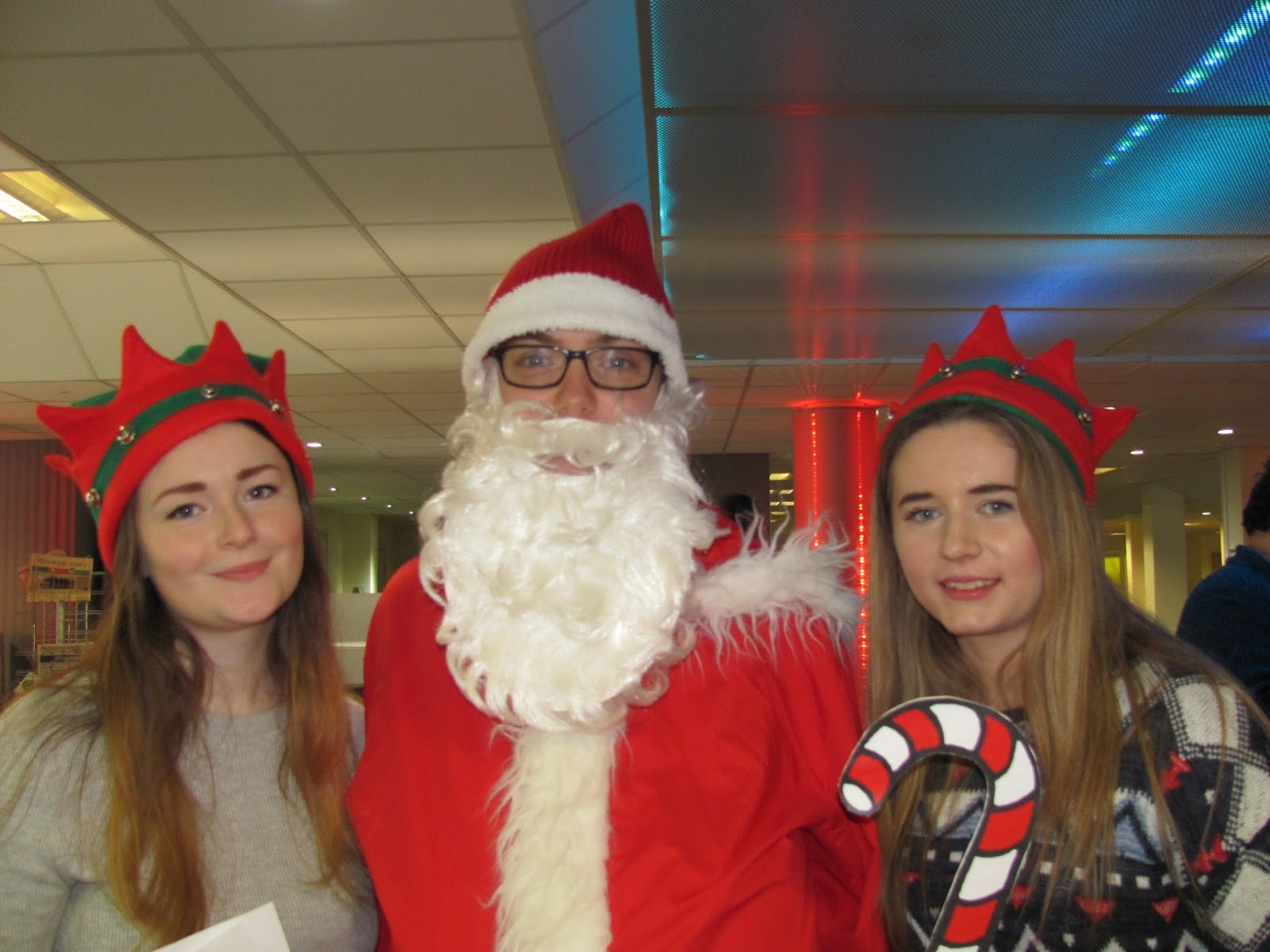
Students and staff had an opportunity to get a selfie with Santa too!

The students raised £136.19.

Monday, 14 November 2016

Game helps Geography students understand the impacts of climate change


We welcomed Frank Sudlow from the Catholic Fund for Overseas Development (CAFOD) to our 'Geography and Development' session last week and he led a simulation exercise on the effects of climate change on poor families from around the Global South.
Students worked in 'family' groups to produce materials for market
Students were divided into six teams of five, each representing a family producing a commodity whose livelihood is being affected by climate change. The families included the Chenge growing coffee in Tanzania affected by increasingly irregular rainfall, the Mendez family from Ecuador suffering from the effects of deforestation and the Chukwa family from Niger producing goat hides. The problem they faced was desertification.
Goods produced by the families
Families took their bundles of coffee, latex, goat hides or other commodities to a market over which they had no control and had to accept whatever the market decided to give them. Poor produce was rejected. As the game proceeded, families often fell below the poverty line and all production stopped until they had completed a set task. At regular intervals a radio message was broadcast impacting on the livelihoods of a particular family.
 
A big queue at the marketplace
The price paid for each good varied throughout the game, according to different climate conditions

A spreadsheet helped to keep a tally of how families were managing and, after several ‘years’, a plenary session helped us to understand the lessons learned. It was clear that climate change is proving to be a major problem for poor families living in the Global South and is seriously limiting their livelihood development. Only one family, through very careful organisation and a certain amount of ‘luck’ managed to progress out of poverty. Most ended up poorer than when they started.

  The quality of goods produced was checked by Dr Kevin Cook and Frank Sudlow
Kevin keeps a close eye on the figures

Everyone agreed that this was an excellent way to be made to think about some of the major effects of climate change.  Thanks Frank for a stimulating and enjoyable session. We hope Frank will be able to join us again next year.
 
Frank provides a summary at the end of the session


Dr Kevin Cook, Senior Lecturer in Geography

Friday, 20 March 2015

Former student talks about health and development in Malaysia and Nepal


Past Northampton student Sonia Coates joined first and second year Geography undergraduates last week to talk to them about her field work in Malaysia and Nepal undertaken as a part of her MSc studies. She covered a range of contemporary issues including migrant health in Kuala Lumpur and child health in a Nepali village. 

Former student, Sonia Coates
Sonia is now working for the Sheffield charity 'The Long Well Walk' and is busy raising funds for water and sanitation projects across Africa. Find out more about her work at http://thelongwellwalk.org/